


Beyond the Basics: 5 Genius Ways Laser Rangefinders Are Solving Tough Problems
When you picture a laser rangefinder, you probably imagine a contractor measuring a living room wall or perhaps a golfer checking the distance to the flag. These are classic, straightforward uses.
Quick Summary: Laser rangefinders go far beyond basic distance measurement. By leveraging precise, non-contact light pulses, they solve complex industrial challenges—from calculating bulk silo inventory and monitoring hazardous chemicals to detecting micro-deformations in machinery, stabilizing drone altitude, and guiding smart robotic grippers.
But the real magic of this technology lies in the hands of ingenious engineers who have taken these precise sensors and applied them to problems you might never have guessed.
Let's explore five creative ways laser rangefinders are proving to be essential tools in industry, science, and smart automation.
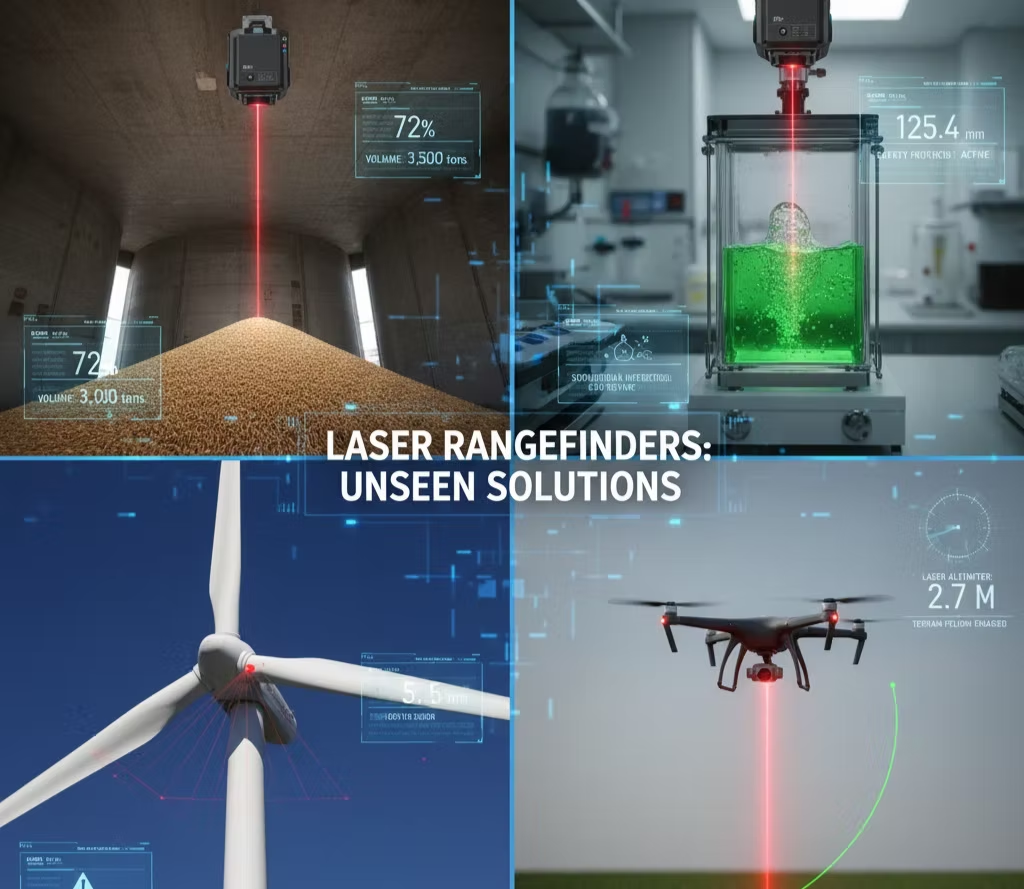
Overview: The 5 Genius Applications
| Application Area | Traditional Challenge | The Laser Solution |
| 1. Bulk Inventory | Risky, manual volume estimation in massive silos. | Ceiling-mounted non-contact distance tracking instantly calculates total volume. |
| 2. Hazardous Chemicals | Contact sensors degrade quickly in corrosive liquids. | Lasers measure liquid levels safely from above through viewing windows. |
| 3. Mechanical Integrity | Micro-distortions in turbines are invisible to the eye. | Real-time distance shifts detect vibrations and stress fractures instantly. |
| 4. Drone Altitude | GNSS (GPS) and barometers lack Z-axis precision. | Downward-facing lasers provide exact ground-level altitude for soft landings. |
| 5. Robotic Automation | Ultrasonic sensors lack angular resolution and speed. | Fast, compact lasers guide dynamic robotic gripping on tight manufacturing lines. |
1. The Digital Silo: Taking Inventory of Bulk Goods
- The Problem: How do you accurately know how many tons of grain, aggregate, or coal you have in a massive silo or warehouse? Traditional methods often involve risky climbing, manual estimation, or expensive, complex scanning systems.
- The Solution: An industrial laser rangefinder is mounted on the ceiling, pointing down at the stock. Because the laser provides a highly accurate, non-contact distance measurement to the surface of the bulk material, software can use this data to quickly calculate the volume.
- Creative Use: By tracking the distance over time, companies can instantly monitor stock levels (inventory management) without ever opening a hatch or sending a worker in. It gives a fast, ballpark figure for what used to be a difficult, time-consuming task.
2. Non-Contact Measurement of Hazardous Chemicals
- The Problem: Measuring the level of highly corrosive, dangerous, or volatile liquids inside sealed, reinforced containers is a major challenge in chemical processing and labs. Traditional contact sensors can be quickly destroyed or risk contamination.
- The Solution: Certain laser wavelengths are perfectly reflected by liquid surfaces. A laser rangefinder is mounted above the container, projecting the beam down through a viewing window or lid.
- Creative Use: The laser accurately measures the distance to the liquid's surface. Since the total height of the container is known, the system can instantly calculate the liquid volume. This non-contact approach is safer for personnel, prevents sensor degradation, and maintains the integrity of the chemical process.
3. Precision Monitoring for Mechanical Integrity
- The Problem: In industrial settings, like precision manufacturing or large structures (e.g., wind turbines), even tiny mechanical distortions can signal a catastrophic failure or a severe drop in efficiency. These subtle shifts are impossible to see with the naked eye.
- The Solution: Multiple laser rangefinders are strategically positioned to monitor critical points. For instance, on a massive wind turbine blade, a change in the laser's measured distance to the blade's surface can immediately indicate a stress fracture or a bending issue.
- Creative Use: This application transforms the rangefinder into a vibration and deformation sensor. It provides real-time, micro-level feedback, allowing for preventative maintenance and ensuring that precision machinery operates within strict tolerances.
4. Enhancing Drone Altitude and Landing Precision
- The Problem: Drones rely on barometric altimeters (air pressure) and GNSS (like GPS) for positioning. While effective, barometric pressure can be affected by weather, and GNSS systems are notoriously less precise on the Z-axis (altitude) because the satellites are always positioned "above" the drone.
- The Solution: A laser rangefinder is added to the drone's belly. It shoots a beam directly down to the ground.
- Creative Use: This provides a highly accurate, localized, and instant ground-level altitude reading. It can supplement or even replace the less precise air pressure data, drastically improving the drone's ability to follow terrain precisely, execute safer ultra-soft landings, and perform low-altitude inspection flights with better stability.
5. Smart Proximity Sensing in Robotics and Automation
- The Problem: Traditional proximity sensors (like ultrasonic) can be slow or lack the fine angular resolution needed for complex robotic tasks, like stacking irregularly shaped objects or navigating tight manufacturing lines.
- The Solution: Fast, small-scale laser rangefinders are integrated directly into robotic grippers and maneuvering systems.
- Creative Use: By constantly monitoring the distance to the object and surrounding environment, the robot can adjust its grip and speed on the fly. This enables intelligent manipulation, allowing robots to work faster, safer, and with higher accuracy, bridging the gap between simple automation and true robotic perception.
From chemical safety to industrial stock management, the laser rangefinder is clearly more than just a fancy tape measure. It's a key component in the new wave of smart sensing and automation, proving that a bit of light and quick math can solve some of the toughest problems in engineering.
Frequently Asked Questions (FAQ)
01
How do laser rangefinders measure inventory in a silo?
They are mounted on the ceiling pointing downward. By measuring the precise distance to the surface of the bulk material and knowing the silo's empty dimensions, software instantly calculates the remaining volume without requiring manual, risky inspections.
02
Are laser rangefinders safe to use with hazardous chemicals?
Yes. Because lasers provide non-contact measurement, the sensor can be mounted outside or above a sealed container, shooting through a viewing window. This prevents sensor degradation and avoids contaminating corrosive or volatile liquids.
03
Can a laser rangefinder detect machine vibrations?
Yes. By strategically positioning high-precision lasers to monitor critical surface points, systems can detect micro-level distance shifts. This real-time data highlights subtle deformations, stress fractures, or unusual vibrations before a catastrophic failure occurs.
04
Why do drones use laser rangefinders if they have GPS?
GNSS (GPS) and barometric altimeters struggle with vertical (Z-axis) precision. A downward-facing laser provides absolute, ground-level altitude in real time, essential for flawless terrain following and ultra-soft autonomous landings.
05
Why choose lasers over ultrasonic sensors in robotics?
Laser sensors offer significantly faster response times and finer angular resolution than ultrasonic alternatives. This allows robotic grippers to instantly adapt to irregular shapes in dynamic, high-speed manufacturing environments.
Technical Sources
The following independent technical resources support the advanced applications of laser rangefinders in automation, drone stabilization, and industrial sensing discussed in this article:
- IEEE Sensors Journal — "Non-Contact Level Measurement Techniques" — Discusses industrial laser and radar applications for bulk and liquid inventory management.
- MDPI Sensors — "Altitude Estimation for UAVs" — Explores sensor fusion utilizing downward-facing laser rangefinders for precise drone landing and terrain following.
- Robotics and Computer-Integrated Manufacturing — Covers the transition from traditional proximity sensors to high-resolution laser sensors in adaptive robotic grasping.
Leave a comment