


The AI SoM: Your Cheat Code for Edge AI Innovation
For years, building an AI-powered product meant hooking it up to the massive, centralized Cloud. But that era is ending. A new, more powerful paradigm has emerged, driven by a ready-to-use solution: the AI System-on-Module (AI SoM).
Quick Summary: The AI System-on-Module (SoM) is a production-ready, miniature supercomputer that brings neural processing directly to edge devices. It bypasses complex hardware routing and solves the three biggest cloud computing headaches: network latency, privacy vulnerabilities, and bandwidth reliance.
Think of the AI SoM not just as a chip, but as a production-ready, miniature supercomputer. It brings the heavy-lifting of AI processing directly to your device—the Edge—allowing R&D teams to bypass complex hardware design and jump straight into solving their unique application problems.
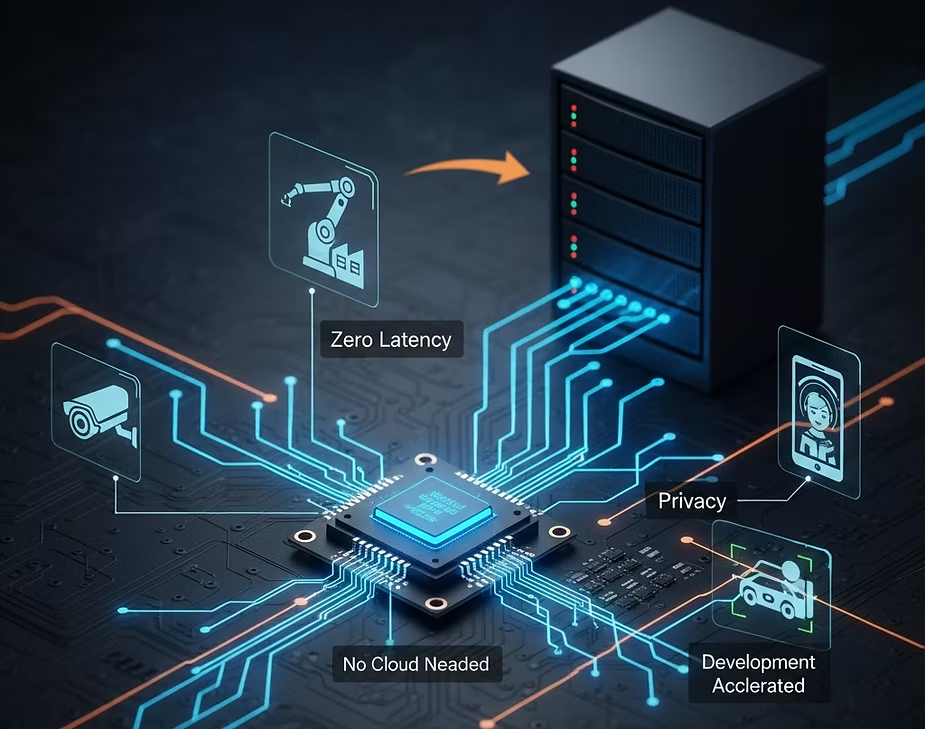
What Exactly is an AI SoM? (The Brain in a Module)
While the AI System-on-a-Chip (AI SoC) is the raw silicon brain, the AI SoM is that brain, plus everything it needs to run, pre-packaged onto a small circuit board.
- Integrated Powerhouse: It packs the main AI SoC (containing the CPU, GPU, and specialized Neural Processing Unit - NPU), plus critical supporting components like high-speed memory (RAM, flash), power management, and all necessary interfaces.
- The Development Accelerator: This is the key for R&D. You don't waste months integrating complex power circuitry or delicately routing high-speed memory traces. It’s all pre-engineered and validated. You simply plug the SoM into your custom carrier board and start coding your application.
- Heterogeneous Compute: The AI SoM is built for efficiency, using the NPU specifically for high-speed, low-power AI inference (running pre-trained models) while letting the CPU handle control logic.
Taming the Edge: Three Headaches Solved by AI SoMs
The AI SoM's primary mission is to decentralize intelligence, executing AI tasks on-device. This instantly solves the biggest headaches associated with relying on the cloud:
| Architecture Challenge | Traditional Cloud AI | Edge AI SoM Solution |
| 1. Latency & Speed | High delay due to network round-trip. Catastrophic for robotics. | Zero Latency: Executes decisions in milliseconds on-device. |
| 2. Privacy & Security | High risk of interception; raw data stored on centralized servers. | Enhanced Privacy: Processes raw data locally; transmits only anonymized insights. |
| 3. Connectivity & Cost | Fails during outages; requires expensive high-bandwidth streaming. | Offline Autonomy: Fully functional offline; drastically reduces data transmission costs. |
1. Zero Latency: Real-Time Decisions Only
Cloud-based AI requires data to travel across the Internet and back. This network round-trip introduces unacceptable latency.
- The Problem: For an industrial robot preventing a collision or an autonomous vehicle detecting an obstacle, a delay of even a few hundred milliseconds is catastrophic.
- The SoM Solution: Processing data instantly on the module reduces delay to mere milliseconds. This enables the true real-time responsiveness essential for safety and high-speed automation.
2. Enhanced Privacy and Security
Shipping raw, sensitive data (live video, voice commands) to a remote server introduces huge security and privacy risks.
- The Problem: Data is vulnerable to interception during transmission and is a major liability when stored centrally.
- The SoM Solution: The SoM runs the AI model locally. It keeps the raw, sensitive data on-device and only transmits the final, anonymized decision (e.g., "Person detected," not the video feed) to the cloud, significantly enhancing compliance and security.
3. Freedom from Connectivity and Bandwidth
Relying on the cloud means your product fails during network outages, in remote areas, or when the connection is weak.
- The Problem: Continuous high-bandwidth video streams for cloud analysis are incredibly expensive, and connectivity is never guaranteed.
- The SoM Solution: Edge devices remain fully functional and intelligent even when offline. By processing and filtering data locally, the SoM drastically reduces the volume of data that ever needs to be sent, saving massive amounts of bandwidth and cost.
Real-World AI SoM Superpowers
The AI SoM is the invisible engine powering the next generation of smart systems:
- Security Cameras: Enables Person/Vehicle Differentiation and sends fewer false alerts, drastically cutting bandwidth (only sends a clip when an event is detected).
- Industrial Robotics: Allows for Predictive Maintenance by analyzing sensor patterns in real-time on-device, preventing catastrophic equipment failure.
- Medical Wearables: Ensures Continuous Health Monitoring with ultra-low power consumption, processing sensitive data constantly without draining the battery.
- Smartphones: Runs Facial Recognition (Face ID) and Real-Time Voice Assistants, ensuring biometrics and private data never leave the device.
Conclusion: Flexibility is the Future
The AI System-on-Module represents a pivotal moment for R&D teams and niche hardware developers.
It serves as a crucial ally, saving months of complex, high-risk electronic design and manufacturing setup. You get to focus your expertise on the unique problem you're solving, not on power supply stability or memory routing.
By solving the fundamental problems of latency, privacy, and connectivity, the AI SoM is not just enabling new edge applications; it is establishing a new standard for intelligent autonomy.
Frequently Asked Questions (FAQ)
01
What is the difference between an AI SoC and an AI SoM?
An AI SoC (System-on-a-Chip) is the bare silicon processor. An AI SoM (System-on-Module) takes that SoC and packages it onto a ready-to-use circuit board alongside essential memory (RAM/Flash), power management integrated circuits (PMIC), and I/O routing, saving engineers months of hardware layout design.
02
What is an NPU and why do AI SoMs need it?
NPU stands for Neural Processing Unit. It is a specialized hardware circuit designed specifically to accelerate machine learning algorithms and neural network inference far more efficiently (with lower power consumption) than a standard CPU or GPU.
03
How does Edge AI improve data privacy?
Edge AI processes sensitive raw data (like live camera feeds or audio) locally on the device itself. Instead of streaming vulnerable data to a cloud server, the module only transmits the final, anonymized metadata (e.g., "object detected"), severely reducing the risk of interception.
04
Why is zero latency critical for edge robotics?
In high-speed automation or autonomous vehicles, a round-trip network delay to a cloud server can cause a crash. Edge AI executes decisions locally in milliseconds, providing the real-time deterministic response required for physical safety.
Technical Sources
The following organizations and resources provide extensive technical documentation on heterogeneous computing and the architecture of Edge AI modules:
- Arm Architectures — Machine Learning on the Edge — Technical insights into NPU integration, heterogeneous compute architecture, and optimizing neural networks for low-power silicon.
- IEEE Xplore — "Edge Computing Architecture and Security" — Peer-reviewed research highlighting how localized processing mitigates cloud latency and network vulnerability.
- Edge Computing Consortium (ECC) — Industry guidelines for standardizing edge-to-cloud interfaces and deploying offline-capable AI systems.
Leave a comment