

The Reign of the Curve: Why Non-Spherical Lenses Dominate Modern AI Optics
For centuries, lens design was simple: use a slice of a perfect sphere. Today, modern optics—from AI vision systems to high-end medical devices—are overwhelmingly dominated by non-spherical, or aspherical, lens elements.
Quick Summary: The evolution of modern AI vision relies heavily on aspherical lenses to eliminate spherical aberration, drastically reducing system size (TTL) and weight (SWaP). Furthermore, for high-energy laser applications, selecting the right material—like Synthetic Fused Silica—is critical to mitigating thermal lensing and maintaining high Laser-Induced Damage Thresholds (LIDT).
They are the quiet heroes responsible for making our phones thin, our camera zooms powerful, and our AI's vision perfectly sharp.
At IntelliGienic, we master this convergence of shape and material, ensuring the optical heart of your system is flawless.
1. The Spherical Problem: The Cost of Simple Shapes
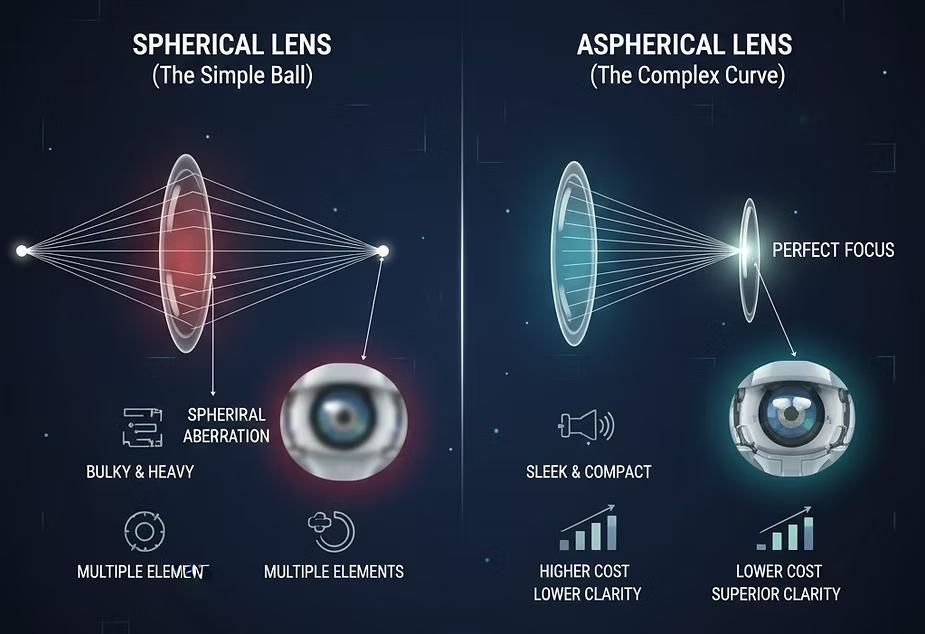
Why can't a simple sphere deliver perfection? A spherical lens cannot focus all incoming light rays to a single, perfect point. Light hitting the edge focuses differently than light hitting the center. This results in spherical aberration, which softens the image, especially around the edges.
The Burden of Spherical Stacks
- The Traditional Fix: Engineers historically used a "gang" of multiple spherical lenses stacked together to cancel out each other’s optical defects.
- Bulky & Heavy: This multi-element approach requires large, complex lens assemblies, severely impacting Size, Weight, and Power (SWaP) constraints.
- High Cost & Imperfection: It increases manufacturing and assembly costs while often still leaving residual optical distortions, such as astigmatism.
2. The Aspherical Solution: One Complex Curve to Rule Them All
Aspherical lenses are the optical revolution. Their surface profile is not uniform; the curvature subtly and continuously changes from the center to the edge based on precise mathematical calculations.
This complex shape achieves the near-impossible:
- Ultimate Clarity: A single aspherical lens can effectively correct spherical aberration, often replacing the job of two or more spherical elements.
- Sleek Design (Low TTL): This reduction in element count allows for a significantly shorter Total Track Length (TTL), which is critical for the ultra-compact camera modules found in modern mobile and IoT devices.
- Edge-to-Edge Quality: The precise focusing power delivers a sharper, clearer image across the entire field of view, maintaining clarity right to the very edges.
3. Beyond Shape: Why Lens Material is Everything for Lasers
While the lens shape handles focusing imperfections, the material it's made from is equally crucial. This is especially true when dealing with high-energy applications like industrial lasers (cutting, welding) or high-speed scanning systems.
For these systems, a poor material choice is not just a performance issue—it's a catastrophic system failure risk.
A. Thermal Lensing: The Hidden Focus Shift
When high-power lasers pass through a lens, a tiny fraction of the energy is absorbed. The center of the lens heats up more than the edges. This heat causes the material's refractive index to shift (the dn/dT effect), which leads to a predictable but problematic Focus Shift. Simultaneously, the material physically bulges due to Thermal Expansion (CTE).
This combined effect is called thermal lensing. It causes the laser beam to defocus or shift its target point, ruining the precision of the process.
| Optical Substrate | Thermal Expansion (CTE) | Refractive Index Temp Coefficient (dn/dT) | Laser Application Suitability |
| Standard Optical Glass (e.g., N-BK7) |
High (approx. 7.1 × 10⁻⁶ /K) | High | Low Power Only: Prone to severe thermal lensing and focus shift under high energy throughput. |
| Synthetic Fused Silica (High-Purity Quartz) |
Extremely Low (approx. 0.55 × 10⁻⁶ /K) | Very Low | High-Power / Ultrafast Lasers: Maintains rigid physical shape and optical performance even under intense MW/cm² energy density. |
B. Laser-Induced Damage Threshold (LIDT)
In ultra-high-power and ultrafast laser applications, the sheer intensity of the light can permanently damage the optical material itself.
- Substrate Quality: Microscopic contaminants or internal defects within the material become initiation sites for catastrophic damage.
- Coating Integrity: The specialized optical coatings (e.g., anti-reflective) applied to the lens surfaces must also have a very high LIDT. A poorly specified coating can act as an absorption site for laser energy, causing a catastrophic failure at the surface long before the bulk glass is affected.
Conclusion: IntelliGienic's Mastery of the Light Path
In modern AI and industrial optics, performance is a synthesis of meticulous engineering. It requires mastering both the aspherical shape and the specialized material properties to deliver uncompromising performance.
At IntelliGienic, our decades of expertise in optics means we don't just specify the glass; we specify the precise shape, material, and coating required to resist thermal lensing and withstand extreme LIDT demands. This ensures the clarity and power required for your most advanced systems.
What complex optical challenge can IntelliGienic help you solve today?
Frequently Asked Questions (FAQ)
01
What is spherical aberration and why is it a problem?
Spherical aberration occurs when a standard spherical lens fails to focus all incoming light rays (especially those hitting the edges) into a single point. This physical limitation causes image softness, edge distortion, and loss of resolution in precision optical systems.
02
How do aspherical lenses reduce system size (TTL)?
Because an aspherical lens uses a complex, mathematically calculated curve, a single element can correct aberrations that would normally require stacking multiple spherical lenses. Reducing the element count drastically shortens the Total Track Length (TTL) and weight of the camera module.
03
What is Thermal Lensing in high-power optics?
Thermal lensing is a phenomenon where high laser energy heats the optical element, causing it to physically expand (CTE) and changing its refractive index (dn/dT). This combined effect acts like an unintended dynamic lens, causing the laser beam to defocus and shift its target point during operation.
04
Why is Synthetic Fused Silica preferred for laser systems?
Synthetic Fused Silica boasts an exceptionally low absorption coefficient and a near-zero Coefficient of Thermal Expansion (CTE). This allows it to resist thermal lensing and maintain pristine optical performance even when subjected to intense, high-power laser irradiation.
05
What does LIDT (Laser-Induced Damage Threshold) mean?
LIDT is a critical metric indicating the maximum laser energy density an optical component (both the glass substrate and its surface coatings) can withstand before suffering permanent physical damage. It is a non-negotiable safety and performance spec for industrial laser cutting and medical ablation tools.
Technical Sources
For further engineering guidelines regarding aspheric manufacturing limits and laser-induced damage thresholds, refer to these industry standards:
- ISO 21254: Test methods for laser-induced damage threshold — The definitive international standard detailing the methodology for measuring and verifying LIDT in high-power optical components.
- SPIE Optical Engineering Journal — Peer-reviewed research exploring the thermo-optic coefficients (dn/dT) and thermal expansion dynamics of precision glass molding materials.
- SCHOTT Advanced Optics — Technical datasheets outlining the superior transmission and low-CTE properties of Synthetic Fused Silica compared to standard N-BK7 optical glass.
Leave a comment