


Picking the Right Heat: A Strategic Guide to Thermal Camera Selection for AI Vision
When you’re building the next generation of "AI Vision," the thermal spectrum offers a "superpower" that standard RGB cameras simply can’t match: the ability to see in total darkness and interpret heat as actionable data.
Quick Summary: Selecting the right thermal camera requires balancing the Johnson Criteria (DRI), pixel pitch miniaturization, NETD sensitivity, and data interfaces (MIPI, USB, CVBS) to optimize Size, Weight, and Power (SWaP) for edge AI integration.
However, for an engineer, choosing a thermal module isn’t as simple as picking a resolution. It is a complex puzzle where physics, material science, and international trade policy all collide.
If you are currently at the drawing board, you might be wondering whether to prioritize pixel pitch or lens material, or how to ensure your drone doesn't fall out of the sky due to a heavy optics payload. This guide breaks down the critical hardware requirements you need to consider to turn your vision into a functional, scalable reality.
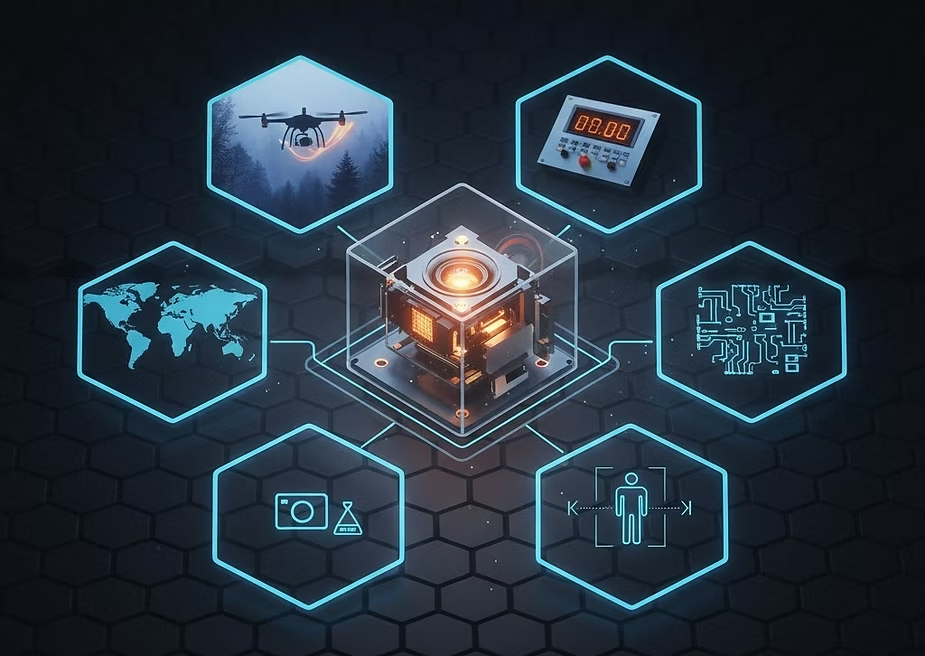
Defining the Mission: The DRI Requirements
Before selecting a lens, you must calculate your "Range of Interest" using the Johnson Criteria. This defines the minimum number of pixels required across a target’s critical dimension (usually a 1.8m tall human) to perform a specific task:
- Detection (D): You see a "blob." You know something is there, but not what it is.
- Recognition (R): You can distinguish the class of object (e.g., "That is a human, not a deer"). This is the baseline for most AI classification models.
- Identification (I): You can see specific details (e.g., "The person is carrying a tool").

Engineering Tip: If your AI requires high confidence for an "Intruder Alert," do not calculate your range based on Detection. Base your lens focal length on the Recognition (R) range to ensure the neural network receives enough spatial data to minimize false positives.
The Pricing Paradox: Sensor and Pixel Size
The industry is rapidly shifting from the traditional 17µm standard to 12µm and 10µm pixel pitch. While shrinking these pixels increases fabrication complexity and can lower initial sensor yields, it offers a massive strategic advantage: Optics Miniaturization.
Because a smaller pixel requires a shorter focal length to achieve the same Field of View (FOV), the physical diameter and weight of the Germanium or Chalcogenide lens can be reduced significantly. Since optics often account for 30% to 50% of a module's total cost, opting for a high-density 12µm sensor can actually lead to a lower total BOM (Bill of Materials) in mass production, while providing a much lighter payload for drone and handheld applications.
Cutting Through the Haze: Fog, Smoke, and Clouds
One of the most powerful advantages of thermal vision is its ability to "see" where the human eye cannot. Because LWIR wavelengths (8μm to 14μm) are much longer than visible light, they can pass through particles like smoke and light fog without scattering.
However, not all fogs are the same. In very dense maritime fog or thick clouds, water droplets can eventually block the signal. This is why Thermal Sensitivity (NETD) is key. A module with a lower NETD can "see" through much harsher atmospheric conditions by distinguishing the tiny temperature differences that survive the trip through the haze.
Sensitivity (NETD): Defining the Grade
Thermal imaging capability largely depends on NETD (Noise Equivalent Temperature Difference). This is the measure of how well the camera distinguishes tiny temperature differences. To ensure your AI Vision has a professional-grade signal, you must understand the industry tiers:
| NETD Level | Industry Grade | Typical Application |
| ≤ 60mK | Commercial / Personal | Basic hobbyist projects, simple proximity sensors. |
| ≤ 50mK | Standard Industrial | General security, standard predictive maintenance. |
| ≤ 40mK | Professional Level | High-end AI Vision, medical screening, drone targeting. |
The Interface: Connecting the "Eye" to the "Brain"
The interface determines how fast and how cleanly data reaches your intelligence center.
| Interface | Signal Type | Best For... | Strategic Advantage |
| Analog (CVBS) | Analog | FPV Drones & UAVs | Zero-buffer, deterministic latency prevents high-speed crashes. |
| MIPI (CSI-2) | Digital | Edge AI SoMs / Automotive | High-bandwidth, native digital connection with minimal CPU overhead. |
| USB (UVC) | Digital | Rapid Prototyping & PCs | Plug-and-play. (Prioritize Native UVC over CVBS-to-USB bridges to avoid latency). |
Radiometry, Power, and SWaP
Finally, consider the "SWaP" (Size, Weight, and Power). For mobile creations, every gram and milliwatt counts.
- Radiometry: Does your AI need to know the exact temperature (e.g., "37.2°C" for a health fever-scan), or just the contrast (e.g., "this person is warmer than the wall")? Radiometric modules require rigorous factory calibration and ambient temperature compensation to maintain accuracy, carrying a higher price than 'imaging-only' sensors.
- Power Consumption: For battery-powered devices, the power draw of the thermal core and its internal shutter (used for calibration) must be factored into your flight or operation time.
A Strategic Choice & Let’s Build Your Vision Together
Selecting "the right heat" is a balance of various factors. Here are some quick notes for you to choose the right one:
- For Drones: Might stick to the 3-wire CVBS for lightness and zero-latency response.
- For Automotive AI: Prioritize MIPI CSI-2.
- For Quality: Demand ≤ 40mK to ensure your AI "Brain" is getting the best possible data.
Finding the perfect balance between DRI requirements, cost-efficiency, and supply chain stability is a daunting task. At IntelliGienic, we don't just supply parts; we provide the architectural insight to ensure your vision becomes a reality.
Ready to select the heart of your next thermal project? Contact our engineering team today to discuss your specs, and let’s turn your heat-mapped ideas into reality!
Frequently Asked Questions (FAQ)
01
What are the Johnson Criteria (DRI) in thermal imaging?
The Johnson Criteria is a standard used to calculate the necessary optical resolution to identify targets. It defines the number of pixels required across a target to achieve Detection (seeing an object), Recognition (knowing the class of object), or Identification (seeing specific details).
02
Why is a smaller pixel pitch (e.g., 12µm vs 17µm) beneficial?
A smaller pixel pitch allows the thermal sensor to use a shorter focal length lens while maintaining the same Field of View (FOV). This drastically reduces the size, weight, and material cost of the optics, lowering the overall BOM and improving drone payload capacity.
03
What is NETD and why does it matter?
NETD (Noise Equivalent Temperature Difference) measures a thermal camera's thermal sensitivity. A lower number (e.g., ≤ 40mK) means the camera is better at distinguishing minute temperature differences, which is critical for seeing through dense fog or achieving high AI accuracy.
04
Which interface should I use for Edge AI systems?
For modern Edge AI and automotive applications, MIPI (CSI-2) is the preferred interface. It offers a native digital, high-bandwidth connection that minimizes latency and CPU power consumption compared to USB bridges.
Technical Sources
The following organizations define the electro-optical standards and interface protocols referenced in this hardware selection guide:
- MIPI Alliance — Camera Serial Interface 2 (CSI-2) — Standardized specifications for high-speed, low-power digital imaging interfaces crucial for Edge AI SoMs.
- IEEE Xplore — Academic papers on the physics of Microbolometer Pixel Pitch Miniaturization and its impact on SWaP (Size, Weight, and Power).
- NIST / NVESD — Foundational literature detailing John Johnson's criteria (DRI) for resolving targets using electro-optical and infrared sensors.
Leave a comment