

SoC, CoM/SoM, SBC, Dev Kit, Embedded Computer, IPC: Which Hardware Level Does Your Edge AI Project Actually Need?
- IntelliGienic
- May 4
- 4 min read

Ask a room of engineers what the difference is between a SoM and an Embedded Computer, and you will get as many answers as there are people in the room. The terms are used loosely — sometimes deliberately so. This article draws the distinctions clearly, because the wrong choice at this stage is one of the most common and expensive mistakes in Edge AI product development.
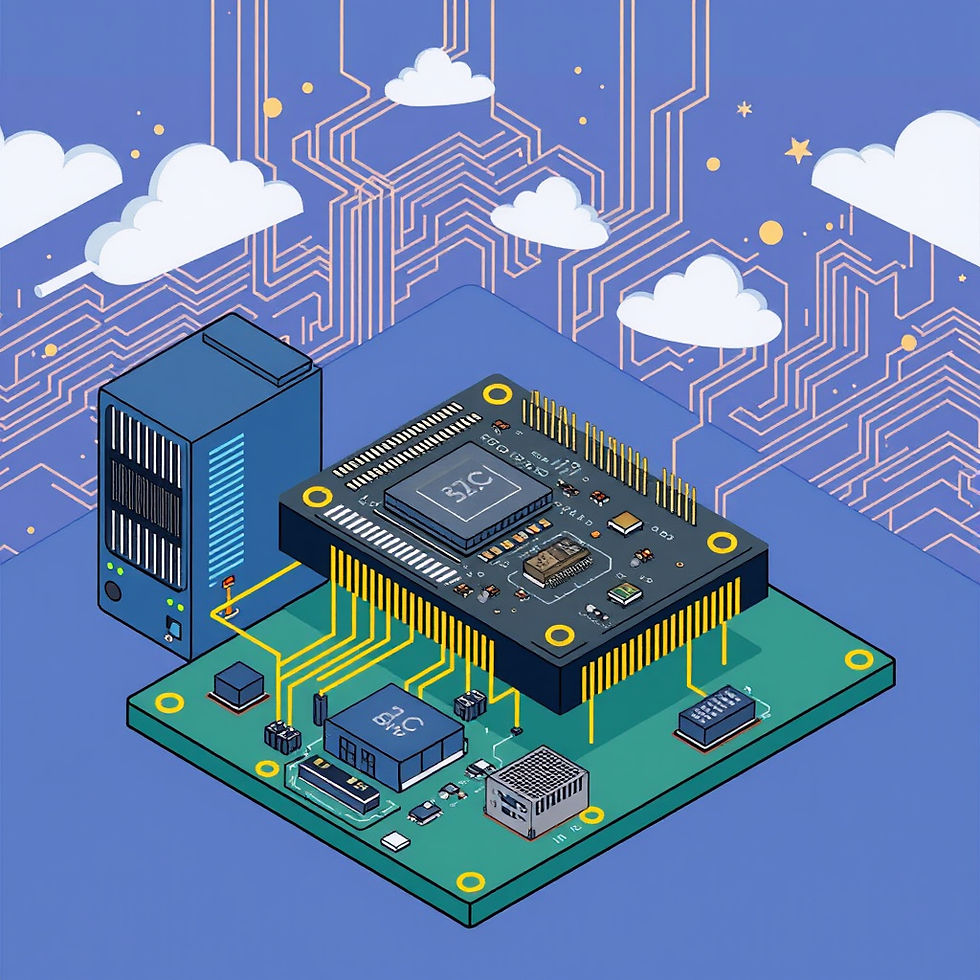
The Seven Levels, Defined Once
These categories nest inside each other, which is the root of the confusion. Here is the hierarchy in plain language:
SoC (System-on-Chip) is a chip. You buy it from a semiconductor vendor and build a board around it from scratch. Everything else on this list is built on top of one.
SoM / CoM (System-on-Module / Computer-on-Module): These terms are often used interchangeably. It is a small, production-tested board with the SoC, memory, and storage integrated. It lacks physical I/O ports, requiring a carrier board to function.
SBC (Single Board Computer): A complete computer on one board. Unlike a SoM, it includes all I/O (USB, Ethernet, HDMI). It is the "ready-to-run" version of a SoM, ideal for projects where a custom carrier board isn't necessary, but a full "Embedded Computer" in a box is too bulky.
Development Kit is typically a SoM paired with a reference carrier board that exposes every interface the SoC offers. It is intentionally over-featured for evaluation purposes. It is not what you ship to customers — it is the tool you use to validate platform fit before committing to carrier board NRE.
Embedded System is not a product — it is a design philosophy. Any hardware-software combination configured to perform one specific task reliably, rather than general-purpose computing, is an embedded system. It can be built on any level above.
Embedded Computer is a product: a self-contained computing unit in a rugged enclosure, ready to integrate into a larger system without additional mechanical work.
IPC (Industrial Computer) is an Embedded Computer rated for factory floors, outdoor enclosures, and continuous 24/7 operation — with sustained thermal performance and supply-chain commitments (typically 10+ years) that commercial hardware cannot match.
The Decision Is About Four Variables
No level is universally better than another. The right choice depends on four project-specific factors evaluated together:
NRE capacity: SoC-level development requires a specialist PCB team and 12–24 months. SoM development with a custom carrier board requires firmware and layout experience and 3–6 months. Embedded Computer integration is primarily a software task, measured in weeks. IPC deployment requires only software configuration.
Customization requirement: Non-standard sensor interfaces, specific optical synchronization topologies, or unusual mechanical form factors push toward SoM or custom board design. Standard I/O profiles are served efficiently by Embedded Computers or IPCs.
Volume and unit economics: High NRE amortizes quickly at volume. Below roughly 1,000–5,000 units annually, the per-unit NRE recovery on a custom carrier board may be poor. Above that threshold, the unit cost advantage of a custom design often justifies it.
Operating environment: Office or controlled-environment deployment suits standard Embedded Computers. Factory floors, outdoor enclosures, or applications requiring sustained AI inference at elevated ambient temperatures require IPC-grade hardware with continuous TDP rating and validated environmental qualification.
Level | Time to First Unit | NRE | Customization | Unit Cost at Scale |
SoC | 12–24 months | Very High | Unrestricted | Lowest |
SoM / CoM + Carrier | 3–6 months | Moderate | High | Low–Moderate |
SBC | 1–2 weeks | None | Low | Moderate |
Dev Kit | Days (eval only) | None | None | Not for production |
Embedded Computer | 4–8 weeks | Low | Limited | Moderate |
IPC | 1–2 weeks | Minimal | Minimal | Higher |

Where IntelliGienic Fits
IntelliGienic is not a hardware manufacturer and not a standard distributor. We are an Edge AI integration specialist — our value is knowing which platform level fits your application, understanding the optoelectronics-to-AI boundary where most integration problems occur, and being able to take a project from platform selection through to a validated, production-ready solution.
In practice, this means two things depending on where your project stands.
Platform selection and integration guidance. If your project is in the architecture phase, we work through the four decision variables with you before any hardware commitment is made. We have hands-on experience across the SoC platforms most relevant to Edge AI vision — from the SigmaStar S531 series (strong ISP heritage, compact power budget, well-suited to smart camera and surveillance analytics) through mid-range platforms like the Rockchip RK3588 and NXP i.MX 8M Plus, up to the NVIDIA Jetson Orin NX for high-throughput multi-stream inference. The match between workload and platform is where we add the most early-stage value.
Custom project delivery. If your application requires a solution that does not exist off the shelf, IntelliGienic offers defined customization engagements with NRE. Two active project platforms illustrate the range:
The SAV531 AI SoC project delivers a complete smart camera or Edge AI vision solution built on the SigmaStar SAV531D — covering hardware platform, ISP configuration, H.265/H.264 encoding, on-chip AI acceleration (IPU/IVE), and a full embedded Linux software stack. This is a proven path for customers building IP cameras, smart surveillance, or embedded vision analytics who need a finished, validated solution rather than a starting point.
The SMARC 2.0 project provides a full-function evaluation carrier board for SMARC 2.0-compliant modules — the right starting point for teams evaluating Computer-on-Module (CoM) platforms before committing to a production carrier board design.
Across both paths, our firmware and software teams are part of the engagement — not a separate contract. The hardware specification, the BSP, the inference runtime configuration, and the optical interface validation are delivered together, because in Edge AI vision applications they cannot be separated.
Start with the Right Question
The most expensive hardware mistake in Edge AI development is not choosing a bad platform — it is choosing the wrong integration level and discovering it after NRE has been spent. If your project is at the architecture stage and the platform decision is still open, that is the right moment for this conversation.
Explore our Customization projects and Services, or contact our engineering team to discuss your application requirements before any commitment is made.


Comments