

SoC, CoM/SoM, SBC, Dev Kit, Embedded Computer, or IPC: Which Edge AI Hardware Level Does Your Project Need?

Updated: Sep 14
Choosing between a System-on-Module (SoM) and an Embedded Computer is not only a processor decision. It is a decision about how much of the system your team must design, validate, manufacture, and support. The wrong integration level can create avoidable non-recurring engineering (NRE), schedule risk, thermal constraints, and redesign work after the AI workload is already fixed.
This Edge AI hardware selection framework compares seven commonly used terms: SoC, SoM/CoM, SBC, development kit, embedded system, embedded computer, and IPC. It then maps each option to four measurable project variables: NRE capacity, customization requirement, annual volume, and operating environment.
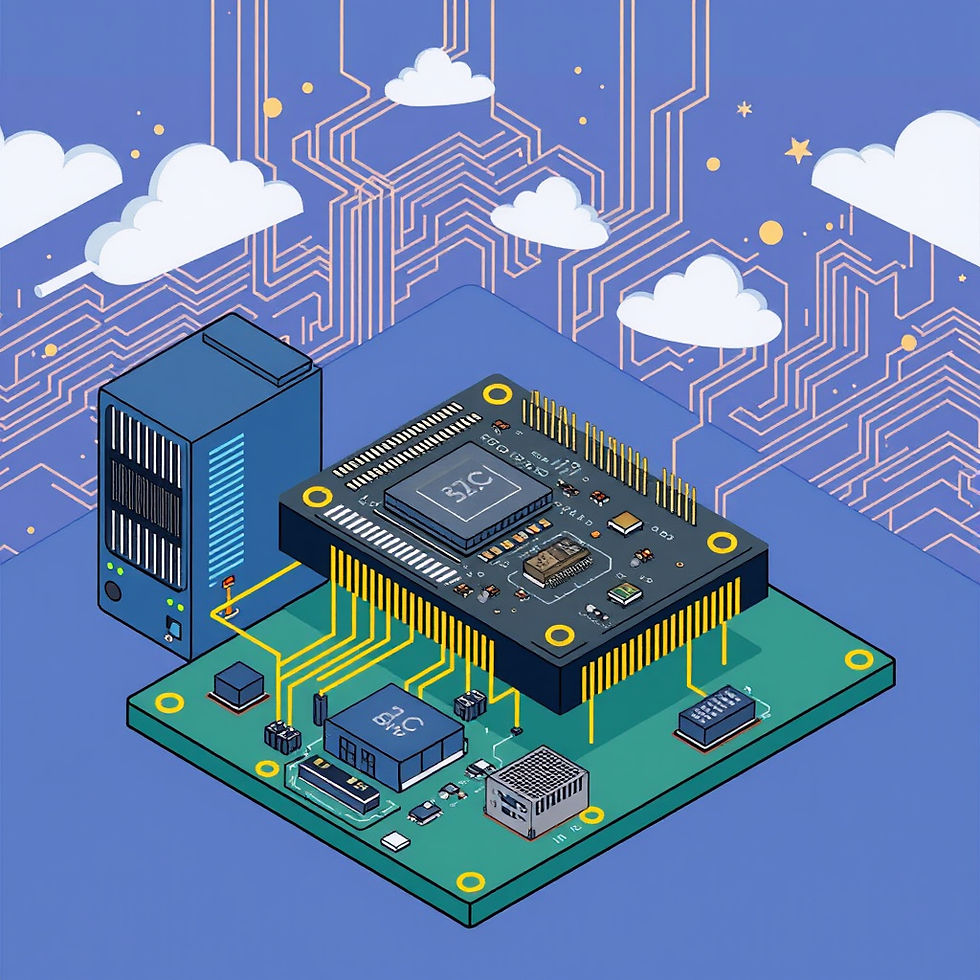
The Seven Edge AI Hardware Levels, Clearly Defined
These terms are related, but they do not describe exactly the same type of object. The most important distinction is whether the item is a chip, a module, a complete board, a development platform, a product enclosure, or a system-design concept.
SoC: The Silicon Foundation A System-on-Chip (SoC) integrates major computing functions on a single semiconductor package. Depending on the device, those functions can include CPU cores, GPU or NPU acceleration, memory controllers, display interfaces, camera interfaces, and other peripherals.
Selecting an SoC means designing the surrounding product electronics yourself. Your engineering scope may include the PCB, power tree, high-speed signal integrity, memory layout, boot firmware, thermal solution, regulatory testing, and production test strategy.
SoC-level development provides the broadest customization, but it also requires the greatest specialist capability and the longest validation path. It is appropriate when the product volume, differentiation, or interface requirements justify owning the complete board design.
SoM or CoM: The Compute Module for a Custom Product A System-on-Module (SoM) or Computer-on-Module (CoM) is a production-oriented PCB that integrates core computing components such as the processor, memory, and selected interfaces. AMD describes a SOM as a production-ready PCB containing processor cores, communication interfaces, and memory blocks for an embedded processing system.1
A SoM normally connects to a carrier board. The carrier board supplies the application-specific I/O, power inputs, connectors, sensors, storage, networking, display paths, and mechanical interfaces that the product requires.
The SoM-plus-carrier-board architecture separates reusable compute from product-specific electronics. This separation can reduce platform risk while preserving control over connectors, camera synchronization, enclosure dimensions, thermal design, and manufacturing configuration.
For a machine vision product, a custom carrier board may be necessary when the system needs non-standard camera interfaces, precise trigger timing, multiple synchronized sensors, specialized lighting control, unusual connector placement, or a compact mechanical envelope.
SBC: A Complete Computer on One Board A Single Board Computer (SBC) combines the processor, memory, power circuitry, and standard I/O connectors on one board. Typical interfaces may include USB, Ethernet, HDMI or DisplayPort, storage expansion, and general-purpose expansion headers.
An SBC is usually the fastest route when the application can use standard interfaces. It avoids the engineering effort of designing a custom carrier board, but it also limits control over I/O placement, board shape, connector selection, thermal path, and product-level integration.
Use an SBC when the project prioritizes rapid proof of concept, low initial NRE, and a ready-to-run development platform. Re-evaluate the choice before production if the SBC creates enclosure, supply-chain, thermal, or certification constraints.
Development Kit: A Platform-Validation Tool A development kit generally combines a SoM or processor module with a reference carrier board. The reference carrier is intentionally feature-rich so that engineers can access many of the processor’s interfaces during evaluation.
A development kit is used to answer platform-fit questions before committing to a production carrier board. Those questions include whether the selected accelerator can meet the inference target, whether the camera pipeline is compatible, whether the BSP supports the required peripherals, and whether the thermal envelope is acceptable.
A development kit is not automatically a production product. It may expose more interfaces than the final design needs, use connectors that do not match the enclosure, or lack the environmental qualification required for field deployment.
Embedded System: A System Concept, Not a Form Factor An embedded system is a hardware-software combination configured to perform a defined function reliably. It is not one specific board type or enclosure.
A smart camera, machine-vision inspection node, autonomous controller, and industrial gateway can all be embedded systems. Each can be built from an SoC, SoM, SBC, embedded computer, or IPC, depending on the product requirements.
This distinction matters because “embedded” does not automatically mean “industrial.” An embedded system deployed in an office has different thermal, lifecycle, ingress-protection, vibration, and maintenance requirements from an embedded system installed on a factory floor.
Embedded Computer: A Ready-to-Integrate Product An embedded computer is a self-contained computing product, usually supplied with a mechanical enclosure, power input, standard I/O, and a defined software environment. It reduces the amount of board-level and mechanical engineering required from the product team.
An embedded computer is suitable when the application can use standard I/O and when the product team values integration speed over maximum hardware customization. It can be a practical middle ground between an SBC and an industrial computer.
IPC: Industrialized Computing for Demanding Sites An industrial PC (IPC) is an embedded computer selected and qualified for demanding operating conditions. Relevant requirements can include continuous operation, elevated ambient temperature, vibration, dust, constrained airflow, serviceability, and long-term product availability.
IPC is not a universal performance grade. It is a deployment and qualification choice. A high-performance consumer platform may deliver more AI throughput at a lower price, while an IPC may provide the thermal design, mounting, environmental qualification, and lifecycle planning required by the customer site.
For this article, “IPC” means an industrialized embedded-computing product with documented environmental and lifecycle requirements. Always verify the vendor’s actual temperature range, power mode, ingress rating, vibration data, warranty, and last-time-buy policy instead of relying on the label alone.

From SoC to SoM/CoM and SBC: an NXP i.MX 8M Plus example of three Edge AI vision hardware integration levels.
The Four Variables That Determine the Right Choice
No hardware level is universally better. The correct choice depends on how the following four variables interact in the specific Edge AI product.
NRE Capacity and Time to First Unit Non-recurring engineering (NRE) includes one-time development work such as architecture, schematic capture, PCB layout, firmware bring-up, BSP integration, mechanical design, validation, and compliance preparation.
A planning benchmark from the original IntelliGienic brief estimates the following time-to-first-unit ranges: approximately 12–24 months for SoC-level development, 3–6 months for a SoM with a custom carrier board, 1–2 weeks for an SBC or IPC integration, and several days for development-kit evaluation. These are planning ranges rather than universal industry guarantees.
The practical rule is simple: move up the integration ladder when your team has sufficient hardware and firmware capacity, and move toward a complete computer when schedule risk is more expensive than the unit-cost premium.
Customization Requirement Customization is the strongest reason to choose a SoM with a carrier board instead of a standard SBC or embedded computer.
A custom carrier board becomes easier to justify when the product needs one or more of the following features: • Non-standard camera or sensor interfaces.
• Multiple synchronized image sensors.
• Application-specific trigger, strobe, or lighting control.
• A custom connector arrangement or compact mechanical outline.
• Special power-input, isolation, storage, or safety requirements.
• A product-specific thermal path or mounting structure. Standard USB cameras, Ethernet, HDMI displays, and common expansion interfaces usually favor an SBC or embedded computer. The cost of a custom board should be compared with the cost of adapting the product around a standard computer.
Annual Volume and Unit Economics Custom hardware has a higher upfront cost and can have a lower unit cost at scale. The relevant calculation is not whether the custom board is cheaper on day one; it is whether the cumulative savings and product benefits recover the NRE over the expected production volume.
A simple break-even model is: “ Break-even volume = incremental NRE ÷ per-unit savings or avoided integration cost ”
The original brief uses approximately 1,000–5,000 units per year as a planning range below which custom-carrier NRE may be difficult to recover. This range is a heuristic, not a market threshold. The actual decision must include board cost, assembly yield, software maintenance, certification, field returns, enclosure adaptation, and expected product lifetime.
A low-volume product may still justify a custom carrier board when the interface or enclosure requirements cannot be met by an off-the-shelf computer. A high-volume product may still use an SBC when the platform is stable, qualified, and economically acceptable.
Operating Environment The operating environment determines whether a platform must be evaluated mainly for functionality or for sustained reliability.
Office and laboratory deployments can often use standard SBCs, development kits, or embedded computers. Factory floors, outdoor enclosures, elevated ambient temperatures, limited airflow, and continuous AI inference require a documented thermal and environmental design.
For an industrial deployment, verify the complete operating envelope. The review should include ambient temperature, sustained total design power, throttling behavior, storage temperature, vibration, shock, humidity, dust, ingress protection, power transients, and service interval.
Edge AI Hardware Selection Benchmark
The following table converts the four variables into an early-stage comparison. “Time to first unit” means the time to an initial integrated hardware unit, not the time to full production qualification.
Hardware level | Typical time to first unit* | NRE level | Customization | Unit economics at scale | Best fit |
SoC | 12–24 months | Very high | Unrestricted | Lowest potential unit cost | High-volume products with unique board requirements |
SoM/CoM + carrier | 3–6 months | Moderate | High | Low to moderate | Machine vision and Edge AI products needing custom I/O |
SBC | 1–2 weeks | None to low | Low | Moderate | Proofs of concept and standard-I/O products |
Development kit | Days for evaluation | None for evaluation | None | Not intended as the production design | Platform, camera, AI-runtime, and BSP validation |
Embedded computer | 4–8 weeks | Low | Limited | Moderate | Fast integration with standard I/O |
IPC | 1–2 weeks for software integration | Minimal | Minimal | Higher | Industrial sites requiring qualified deployment hardware |
*The schedule ranges are planning benchmarks from the supplied IntelliGienic brief. Actual timing depends on platform availability, software readiness, certification, mechanical work, supply-chain constraints, and test scope.
A Five-Step Workflow for Choosing SoM, SBC, or IPC
Step 1: Define the Workload Before Comparing Processors Document the number of camera streams, image resolution, frame rate, codec requirements, model type, precision, latency target, storage load, and network throughput. “AI performance” is not one universal number because TOPS values depend on precision, sparsity, model, software stack, and measurement conditions.
Step 2: List Interfaces That Cannot Change Separate mandatory interfaces from preferred interfaces. Mandatory items can include MIPI CSI-2 lanes, trigger timing, encoder channels, isolated I/O, industrial Ethernet, display outputs, storage, and power inputs. If a mandatory interface is absent from the standard computer, the project should evaluate a SoM with a custom carrier board or a custom SoC board. If all mandatory interfaces are available, an SBC or embedded computer may reduce NRE.
Step 3: Validate the Platform with a Development Kit Use a development kit to validate the camera pipeline, ISP configuration, video encoding, AI acceleration, thermal behavior, and embedded Linux software stack. Record measured latency, sustained throughput, memory usage, power draw, and temperature rather than relying only on vendor peak figures.
Step 4: Calculate the Integration-Level Break-Even Point Estimate one-time NRE, unit cost, expected volume, product lifetime, certification effort, field-service cost, and the cost of adapting the enclosure to an off-the-shelf platform. Use the break-even formula before approving a custom carrier board.
Step 5: Review Production and Lifecycle Risks Confirm component availability, module revision policy, BSP maintenance, kernel and driver support, security-update process, manufacturing test access, thermal margin, and replacement strategy. A platform that passes a demonstration may still be unsuitable for a product with a multi-year support commitment.
Platform Examples for Edge AI Vision Projects
The following platforms illustrate why workload-to-platform matching is more useful than ranking processors by a single performance number.
SigmaStar S531 Series for Compact Smart-Camera Workloads
The original IntelliGienic brief positions the SigmaStar S531 series for compact smart-camera and surveillance analytics applications because of its ISP heritage and compact power budget. The relevant evaluation questions are camera input compatibility, ISP tuning effort, H.264/H.265 encoding requirements, on-chip AI acceleration, memory bandwidth, and the sustained thermal envelope.
IntelliGienic’s described SAV531 AI SoC project is a complete smart-camera or Edge AI vision path built on the SigmaStar SAV531D. The described scope includes the hardware platform, ISP configuration, H.265/H.264 encoding, IPU/IVE on-chip AI acceleration, and an embedded Linux software stack.
This type of project is intended for customers who need a validated smart-camera foundation rather than an unintegrated processor starting point. Product claims, supported models, and measured performance should be confirmed against the final bill of materials and software release before publication or quotation.
Rockchip RK3588 for Mid-Range Edge AI Integration
The original brief identifies Rockchip RK3588 as a mid-range option for Edge AI systems. Its suitability should be assessed using the complete workload profile, including camera count, decode and encode concurrency, NPU runtime support, memory capacity, display requirements, and power mode.
The correct comparison is not “which platform has the largest TOPS number.” The correct comparison is whether the target model, camera pipeline, operating system, drivers, and thermal design can sustain the required throughput in the final enclosure.
NXP i.MX 8M Plus for Industrial Edge and Vision Control
NXP lists the i.MX 8M Plus with an NPU of up to 2.3 TOPS, quad or dual Arm Cortex-A53 processing up to 1.8 GHz, and a Cortex-M7 real-time core up to 800 MHz.
These figures make the platform relevant to lower-power vision and industrial-control designs, but peak NPU throughput is only one selection input. The team should also validate camera support, model conversion, real-time behavior, memory bandwidth, Linux BSP maturity, and the required product lifecycle.
NVIDIA Jetson Orin NX for High-Throughput Multi-Stream Inference
The NVIDIA Jetson Orin NX data sheet lists up to 100 sparse INT8 TOPS and 50 dense INT8 TOPS for the 16GB version, and up to 70 sparse INT8 TOPS and 35 dense INT8 TOPS for the 8GB version.
The sparse and dense figures must not be compared directly with another vendor’s TOPS number unless precision, sparsity assumptions, model, batch size, and runtime conditions are aligned. For a multi-stream vision system, measure end-to-end performance, including image capture, preprocessing, inference, postprocessing, encoding, networking, and thermal throttling.
SMARC 2.0 as a Standardized Computer-on-Module Path
SMARC is a standardized small-form-factor computer-module architecture. SGET describes SMARC as targeting low-power, low-cost, high-performance applications and specifies typical module power below 6 W.
SGET defines two SMARC module sizes, 82 mm × 50 mm and 82 mm × 80 mm, with 314 edge fingers mating to a low-profile 314-pin, 0.5 mm-pitch connector. The module concentrates core computing and support circuits, while the carrier board implements application-specific functions.
IntelliGienic’s described SMARC 2.0 project provides a full-function evaluation carrier board for SMARC 2.0-compliant modules. It is intended to help teams evaluate Computer-on-Module platforms before committing to a production carrier-board design.
Where IntelliGienic Adds Value
IntelliGienic positions itself as an Edge AI integration specialist rather than a standard hardware distributor. The core value is selecting the appropriate platform level, identifying integration risks between optoelectronics and AI processing, and carrying the design toward a validated production solution.
For projects in the architecture phase, the engineering discussion should begin with the four decision variables: NRE capacity, customization, volume economics, and operating environment. This prevents a processor choice from being made before the system-level constraints are understood.
For projects that need a non-standard product, IntelliGienic describes defined customization engagements with NRE. The SAV531 AI SoC path represents a smart-camera and embedded-vision solution, while the SMARC 2.0 path represents a standardized CoM evaluation and carrier-board route.
Hardware and software must be planned together in an Edge AI vision product. The hardware specification, BSP, inference-runtime configuration, camera or optical-interface validation, and thermal measurements affect one another and should be reviewed as one delivery scope.
Conclusion: Start with the Integration Question
The most expensive Edge AI hardware mistake is often not selecting a weak processor. It is selecting the wrong integration level and discovering the mismatch after NRE, firmware, mechanical, and validation work has already been completed.
Use a development kit to prove platform fit, a SoM plus custom carrier to balance customization and product control, an SBC or embedded computer to accelerate standard-I/O integration, and an IPC when the deployment environment requires documented industrial behavior.
If the project is still in the architecture phase, now is the right time to compare the workload, interfaces, NRE, volume, thermal envelope, and lifecycle requirements before hardware commitments are made. Explore IntelliGienic’s customization projects and services, or contact the engineering team to review the application requirements.
Frequently Asked Questions (FAQ)
What is the difference between a SoM and an SBC? A SoM integrates the core computing components but normally needs a carrier board for application-specific I/O. An SBC is a complete computer on one board with standard connectors already exposed. Choose a SoM when the product needs custom interfaces, timing, power, or mechanical integration; choose an SBC when standard I/O and fast integration are the priority.
Do I always need a custom carrier board with a SoM? Yes, a SoM normally requires a carrier board to provide power, connectors, storage, sensors, displays, and application-specific interfaces. The carrier can be a vendor reference board for evaluation or a product-specific board for production. A development kit helps validate the module before the production carrier-board design is committed.
Is a development kit suitable for shipping in a final product? Not by default. A development kit is usually over-featured for evaluation and may not meet the final product’s mechanical, thermal, environmental, certification, connector, or lifecycle requirements. It can be used as a production platform only after those requirements are explicitly verified and the vendor permits that use.
When should an Edge AI project use an IPC instead of a SoM? Use an IPC when the project needs a ready-to-integrate enclosure, standard I/O, documented thermal behavior, industrial mounting, serviceability, or continuous operation in a demanding site. Use a SoM when the project needs custom camera interfaces, unusual synchronization, a compact enclosure, or product-specific power and connector design.
How many units justify a custom carrier board? There is no universal volume threshold. The decision depends on NRE, per-unit savings, product lifetime, certification cost, software maintenance, enclosure adaptation, and field-service risk. The original planning brief uses approximately 1,000–5,000 units per year as a heuristic range, but each project should calculate its own break-even volume.


Comments