

Precision vs. Distance: Navigating the Laser Sensor Landscape

Updated: Apr 7
In industrial design, the term "laser sensor" often serves as a catch-all. However, for engineers and project managers, selecting the wrong type of laser module can mean the difference between a successful deployment and a system failure.
At IntelliGienic, we categorize our laser solutions into two primary families: Laser Distance Sensors (LDS) and Laser Rangefinder (LRF) Modules. While both measure the gap between point A and point B, their internal logic and operational intent are worlds apart.
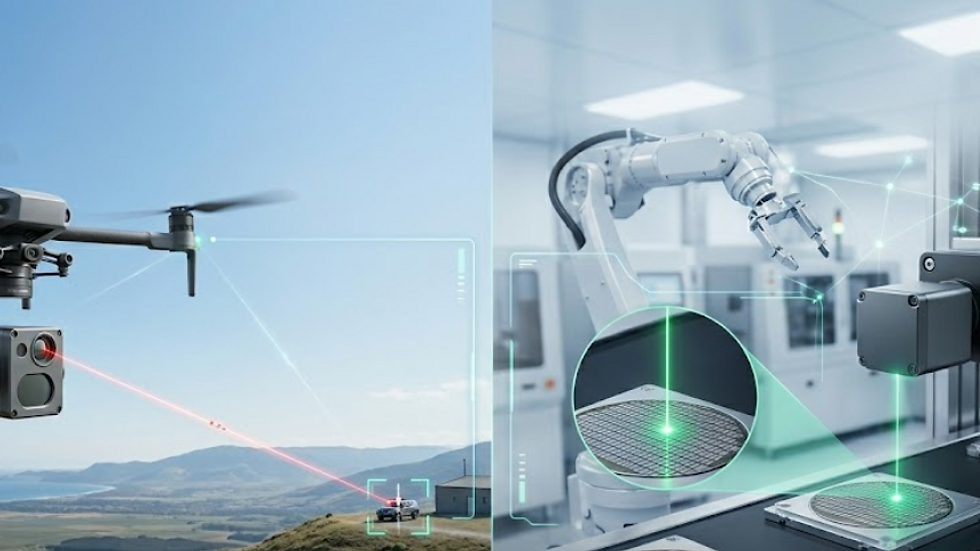
Laser Distance Sensors (LDS): The High-Speed Watchman
An LDS is built for intelligence and immediacy. In a smart factory or robotic environment, you don't just need to know how far an object is—you need to know now.
The "Speed" Factor: Our LDS solutions, such as the High-Frequency (HS) Series, are optimized for real-time response. Capable of sampling up to 20,000 times per second (20KHz), these sensors can detect an object passing at high velocity or monitor micro-vibrations that a standard sensor would miss.
The "Precision" Factor: For indoor applications like semiconductor inspection or quality control, our Precise (PS/PD) Series utilizes phase-shift technology to achieve millimeter-level accuracy.
Best For: Automated "Tripwire" alarms, collision avoidance, and high-speed sorting lines.
Laser Rangefinder (LRF) Modules: The Long-Range Navigator
An LRF is engineered for reach and endurance. These are the "scouts" of the laser family, designed to provide accurate data over distances where an LDS would lose its signal.
The "Reach" Factor: While an LDS excels in short-to-mid ranges, our Long-Distance (LS/LH) Series LRFs are designed for the "unknown." Using pulsed (D-ToF) technology, these modules can measure targets at distances of 3km (LS Series) to over 10km (LH Series).
The "Environment" Factor: Outdoor ranging faces two enemies: sunlight and atmosphere. By utilizing specialized wavelengths—905nm for standard industrial use and 1535nm for high-end "eye-safe" penetration—these modules can "see" through haze and smoke that would blind a standard sensor.
Best For: UAV/UGV navigation, target acquisition in defense platforms, and long-range infrastructure surveying.
Key Technical Distinctions
FeatureLaser Distance Sensor (LDS)Laser Rangefinder (LRF) | ||
Primary Goal | Instant detection / High-speed monitoring | Mapping / Long-range target measurement |
Measurement Rate | High (Up to 20,000Hz) | Low (Typically 1–10Hz) |
Wavelengths | 650nm (Visible) / 905nm | 905nm / 1535nm (Eye-Safe) |
Data Output | Real-time continuous stream | On-demand / Low-frequency pulses |
Environment | Optimized for Factory/Robotics | Optimized for Outdoor/Challenging Vistas |
Making the Strategic Choice
When we partner with clients on custom JDM or ODM solutions, the choice usually comes down to a single question: "Are you monitoring a process, or are you navigating a world?"
If you are building a safety system where a robot must stop the millisecond a human hand enters a zone, you need the high-frequency response of an LDS.
If you are building a surveillance gimbal that needs to identify a vehicle 5 kilometers away, the atmospheric penetration of a 1535nm LRF is non-negotiable.
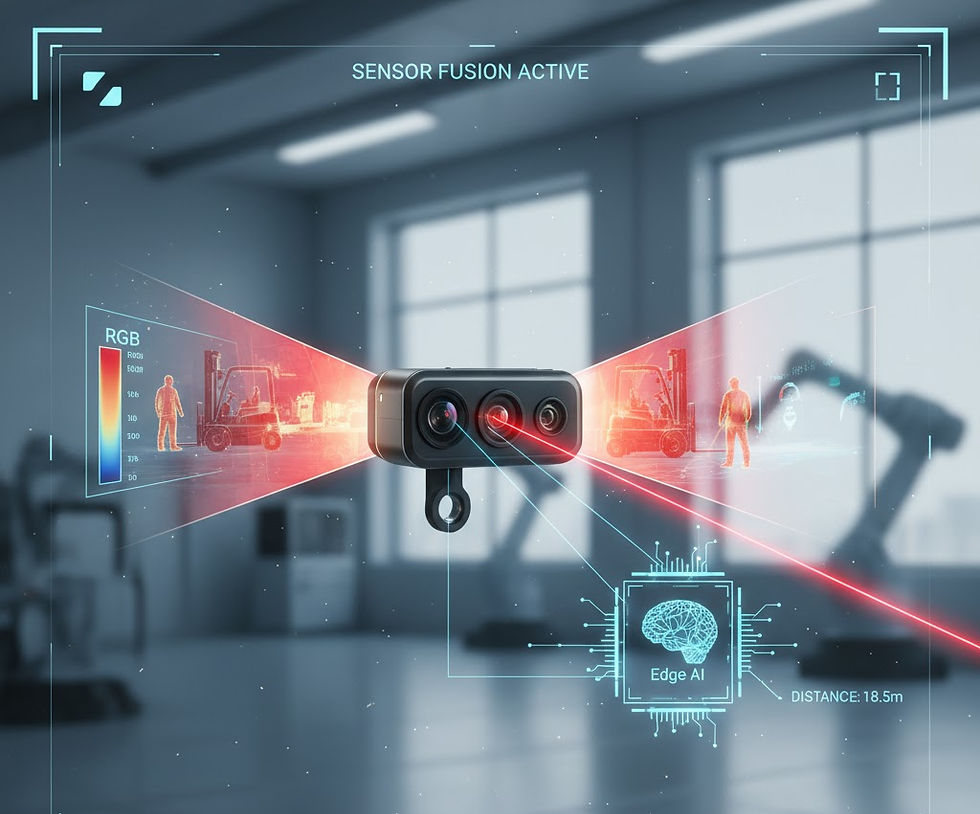
At IntelliGienic, we provide the technical bridge between these high-performance laser modules and your Edge AI architecture. Whether you need micrometer precision in a cleanroom or 10km ranging in the field, our specialized series are designed to provide the stable, precise data your system demands.
Need a technical deep-dive into which laser series fits your next development? *Contact our engineering team for a consultation on optical integration and interface customization
Conclusion: Empowering Your Innovations
In the rapidly evolving landscape of industrial technology, making informed choices about laser sensors is crucial. The right selection can accelerate your product development and enhance the reliability of your systems.
At IntelliGienic, we are committed to empowering your innovations. Our expertise in optoelectronics and AI positions us as your reliable partner. We help you navigate complex challenges and unlock new possibilities. Together, we can bring your intelligent creations to life.
By understanding the distinctions between LDS and LRF modules, you can make strategic decisions that align with your project goals. Whether you aim for high-speed monitoring or long-range navigation, we are here to support you every step of the way.
Explore our laser solutions today and discover how we can help you accelerate your innovation journey.


Comments