

The First Step in Robotics: Why Sensing is the Blueprint for Success

Updated: Mar 27
The future of everyday robotics isn't just about movement; it's about intelligent perception. Whether you are building an Autonomous Mobile Robot (AMR), a precision folding arm, or a smart healthcare monitor, the device must first accurately sense, understand, and reason about the world.
To succeed in complex, unscripted environments—from cluttered hospital hallways to retail floors—your project needs more than basic vision; it needs a validated sensing foundation.
The decision and integration of your sensing hardware, including the strategic use of Edge AI, determine the entire success or failure of your robotics project. Never forget the foundation.

Why Sensing is the Cornerstone, Not an Afterthought
In practical robotics, the mechanical body is easy to copy, but the intelligence pipeline is the core intellectual property. Rushing directly to final assembly without validating your sensing strategy creates massive, avoidable risk.
The Cost of "Wrong" Data or Missing Data (Sensing Fusion)
Your AI model's performance is entirely dependent on the quality and format of the input data.
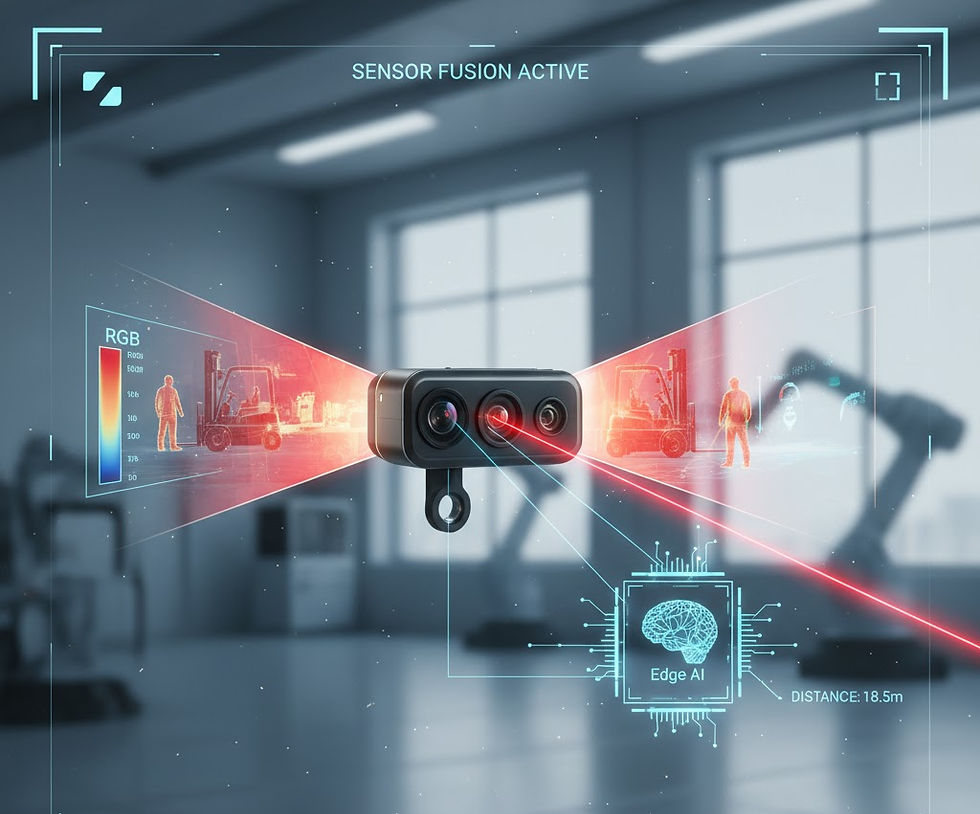
Wrong Sensor Selection: If you choose a 2D camera when you needed depth data, or if you rely solely on vision when a simple, inexpensive thermal sensor or lidar could provide critical, complementary data, your system will fail in real-world scenarios. The AI model needs comprehensive, fused input to make robust decisions.
Edge-Sensor Mismatch: You might train an incredible model, only to find the raw data rate from your high-resolution sensors (e.g., 4K @ 60 FPS) is too high for your chosen Edge AI System-on-Module (SoM) to ingest while simultaneously running the AI model. This leads to dropped frames and unreliable inference.
Model-Hardware Bottleneck
Every practical robotics project must live within thermal and power constraints.
The TOPS/Watt Trap: An unoptimized model may require too many tera operations per second (TOPS) to run efficiently on your chosen SoM. This results in high latency, excessive power consumption, and thermal issues that kill your project's viability outside a laboratory.
The PoC Mandate: A Proof of Concept (PoC) forces you to tune the Inference Model Selection/Training/Tuning specifically for your target AI SoM's hardware, ensuring your core intelligence is efficient at the edge.
The Sensing PoC Roadmap: Four Foundational Steps
A well-executed PoC systematically validates the sensing and processing pipeline before any significant capital is deployed on mechanical or custom hardware.
Step 1: Sensor & SoM Selection Validation
Core Objective: Validate the pairing of all opto-electronic modules and supplemental sensors (LiDAR, thermal, ultrasonic) with the Edge AI SoM.
Why it's Critical: This step ensures the system captures the right data and that the processor can handle the raw data rate (e.g., can the SoM ingest and process three different sensor feeds simultaneously?). This validates the physical foundation of your sensor fusion strategy.
Step 2: Interfacing and Data Integrity
Core Objective: Establish stable communication and integrate necessary OS/drivers on the development board.
Why it's Critical: Confirms interfacing compatibility and allows you to immediately verify the integrity of the data stream. Catching low-level driver bugs or data loss issues here saves massive time and cost before custom hardware fabrication starts.
Step 3: Model Tuning and Edge Efficiency
Core Objective: Achieve target accuracy, latency, and power consumption for the specific task.
Why it's Critical: Proves the inference model is quantized and optimized enough to run on the AI SoM at the edge (e.g., object detection at 30 FPS, not 5 FPS). This step validates the robot's core intelligence and commercial viability.
Step 4: Real-World Feasibility
Core Objective: Test the end-to-end AI function in the actual target environment.
Why it's Critical: Uncovers those nasty edge cases—unexpected reflections, temporary thermal gradients, dust, or specific human interactions—that simulation cannot replicate. This prevents catastrophic late-stage adjustments or product recalls.
Your Partner in De-Risking Practical Robotics
The complex interplay between hardware (fused sensors, AI SoM, custom carrier board), low-level software, and high-level AI is why most robotics projects fail to scale.
You don't just need components; you need a cohesive, de-risked strategy focused on the foundation.
Technical De-Risking: We guide you through the initial selection process, matching the ideal sensor package and Edge AI SoM to your use case, ensuring your PoC is built on a solid, fusable foundation.
Accelerated Iteration: We provide the expertise in Model Tuning to quickly adapt complex models for optimal edge performance, drastically shortening your path from idea to validated blueprint.
Start with the essential Sensing PoC. Stop guessing and start validating. Let's ensure your next everyday robotics project has the intelligence it needs before you invest in its mechanical body.

Comments