

Thermal Imaging for AI Vision: The Zero-Photon Advantage

Updated: Sep 15
For AI vision, thermal imaging adds passive long-wave infrared sensing, enabling detection of temperature contrast in total darkness and often preserving useful contrast through smoke or haze. It is not a zero-limit sensor: rain, glass, occlusion, emissivity and range still constrain performance.
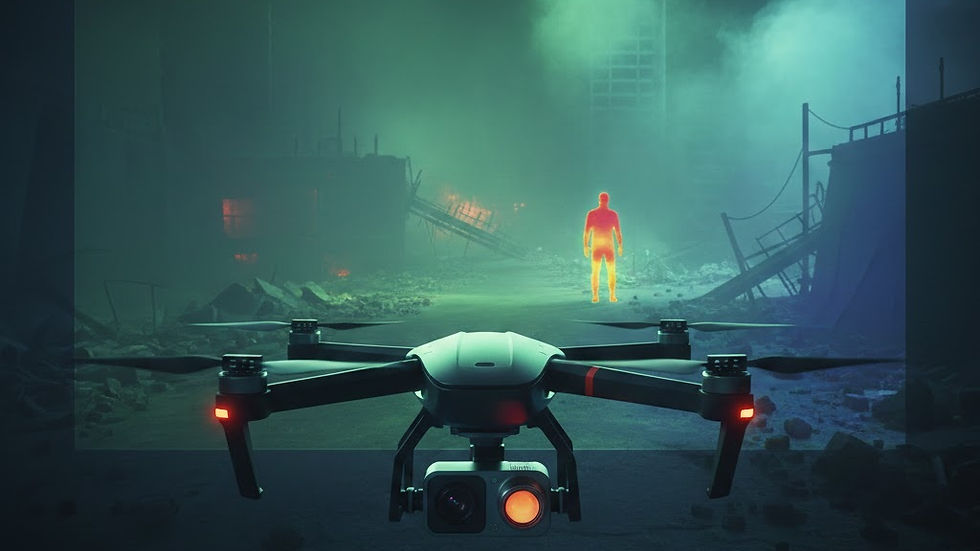
When engineers evaluate an AI camera, the discussion often starts with pixel count, frame rate and color fidelity. Those specifications matter in controlled light, but they do not describe how a system behaves when illumination changes faster than the model can adapt. A thermal camera adds a different signal: temperature-dependent infrared radiation rather than reflected visible light.
“Zero-photon advantage” is a positioning phrase, not a literal physics claim. A long-wave infrared sensor still receives infrared photons. The practical advantage is that it does not require visible illumination or an onboard light source to produce a useful thermal image. (Opto-E, “IR Optics”)
Why thermal imaging changes the AI-vision risk profile
A visible-light camera estimates scene appearance from reflected light. Shadows, glare, backlight and low illumination can therefore reduce the separation between a target and its background. Thermal imaging measures radiated energy and maps temperature differences into image contrast, so it can preserve a target cue when the visible image becomes ambiguous. (FLIR, “What’s The Difference between Thermal Imaging and Night Vision?”)
Night vision and thermal imaging are not the same Night vision normally amplifies available light, which may include near-infrared illumination. Thermal imaging belongs to a different sensing class: it detects emitted thermal radiation in bands such as MWIR and LWIR. A sealed, unlit room can therefore be difficult for an image-intensifier system while still producing thermal contrast for an LWIR camera.
Question | Image intensification / low-light night vision | Thermal imaging |
Primary signal | Available or reflected visible / near-infrared light | Emitted infrared radiation and temperature contrast |
External illumination | Usually needs some ambient light or active IR illumination | Does not require visible light or an illumination lamp |
Color and texture | Can retain familiar scene texture when enough light exists | Usually emphasizes thermal contrast rather than visible color |
Typical failure modes | Darkness, backlight, glare and low photon counts | Occlusion, low thermal contrast, rain, atmospheric attenuation and emissivity error |
AI design implication | Useful for appearance and fine texture | Useful as a complementary signal for robust detection and tracking |
The LWIR band: why 8–14 μm is widely used
Long-wave infrared, or LWIR, commonly covers approximately 8–14 μm. Mid-wave infrared, or MWIR, commonly covers approximately 3–5 μm. Both are thermal bands because objects emit radiation without an external light source. Atmospheric absorption creates transmission windows, so the selected band must match the target, distance and environment. (Opto-E, “IR Optics”)
A simple physics check explains why human-scale heat is relevant to LWIR. Using Wien’s displacement relationship, λmax ≈ 2,898 μm·K / T, a 307 K surface has an emission peak near 9.44 μm. That value falls inside the LWIR band. The calculation does not guarantee detection, because contrast, distance, optics and background conditions still determine the final image.
What thermal cameras measure: temperature contrast and emissivity
A thermal image is not a direct picture of “heat” in the everyday sense. It is a measurement of infrared radiance that depends on temperature, emissivity, reflection, transmission and the atmosphere between the target and the sensor. The same physical temperature can therefore produce different readings when surface properties change. (Opto-E, “IR Optics”)
Material example | Representative emissivity value | Why it matters |
Human skin | 0.98 | High emissivity commonly produces a strong thermal signal relative to many backgrounds. |
Water | 0.95 | Thermal contrast can reveal water boundaries and temperature gradients. |
Polished aluminium | 0.10 | Low emissivity makes reflected surroundings more influential in the measurement. |
Anodized aluminium | 0.65 | Surface treatment changes the apparent thermal response of the same base metal. |
Cloth | 0.95 | A visible covering may still carry a measurable thermal pattern, but insulation can reduce contrast. |
These values are representative material data, not universal constants for every finish, angle or wavelength. A model trained on thermal images should therefore be validated across surface treatments and backgrounds rather than assuming that one thermal signature represents an entire object class.
Thermal imaging in fog, smoke and glare: an advantage with conditions
Longer infrared wavelengths generally experience less scattering from some atmospheric obscurants than visible light, which is why LWIR can retain useful target contrast in selected smoke, dust or haze scenes. This is an advantage in perception design, not a promise of unlimited penetration. (Opto-E, “IR Optics”)
Water droplets and atmospheric gases still scatter or absorb infrared radiation. FLIR notes that fog and rain can reduce thermal range and target contrast, and that rain-related degradation is strongly range-dependent; its technical discussion highlights a possible sharp decline in the 100–500 m range. That interval is an engineering reference example, not a universal pass/fail threshold for every camera or weather condition. (FLIR, “Can Thermal Imaging See Through Fog and Rain?”)
A practical scene-by-scene expectation
Scene condition | Likely thermal benefit | Required qualification |
Total darkness | Thermal contrast remains available without visible illumination. | Low target-to-background temperature difference can still reduce detection confidence. |
Backlight or headlight glare | Thermal sensing can avoid saturation from visible glare. | Hot lamps, exhausts or reflective surfaces may introduce competing signals. |
Light smoke or haze | LWIR may retain more target contrast than RGB in some paths. | Smoke density, path length, humidity and particle properties determine the result. |
Heavy rain or dense fog | Thermal may remain informative at shorter ranges. | Attenuation and scattering can reduce both contrast and usable range. |
Behind ordinary window glass | The glass surface may be measurable as a thermal object. | Standard glass is opaque in the infrared; use an IR-transmissive window when enclosure protection is required. |
The glass paradox: thermal sensors need the right window
A conventional camera can look through ordinary window glass because glass transmits visible light. An LWIR camera normally cannot use that same window as a transparent cover. FLIR explains that common glass is opaque to infrared, while materials such as germanium transmit infrared and are used for thermal-camera lenses. (FLIR, “What Are IR Camera Lenses Made Of?”)
This creates a common integration error: placing a thermal module behind a standard protective pane and expecting the sensor to see the outdoor scene. The camera instead measures the pane’s surface, its reflections and its temperature. A production enclosure should specify an IR-transmissive window, anti-reflection treatment, sealing method and environmental rating as one optical subsystem.
Chalcogenide glass is another option for IR optics. Its transmission profile and thermal behavior can be tailored by formulation, making it a potential alternative to germanium for selected designs. Material selection still depends on band, transmission, durability, thermal stability, cost and supply-chain requirements. (Avantier, “Chalcogenide as an Alternative to Germanium for IR Optics”)
Passive sensing as a de-risking strategy
A thermal camera is a passive receiver: it collects emitted infrared energy instead of transmitting a ranging signal. That reduces one class of interaction risk in a crowded sensing environment because the thermal channel does not add an active RF or acoustic emission to the scene.
Passive does not mean interference-proof. Thermal data can be degraded by atmospheric attenuation, reflections, sensor noise, calibration drift, lens contamination, occlusion and weak target-background contrast. The correct claim is that passive infrared sensing provides a complementary measurement path with a different failure profile from active ranging sensors.
Engineering data: what “AI-ready” should mean
Thermal performance cannot be summarized by resolution alone. A system integrator should evaluate spatial sampling, field of view, lens transmission, focus stability, frame rate, radiometric behavior and Noise Equivalent Temperature Difference, or NETD. NETD is commonly expressed in milli-Kelvin; a lower value indicates sensitivity to smaller temperature differences under comparable test conditions.
Specification category | Illustrative published values | Interpretation for AI integration |
Detector resolution | 80 × 60; 160 × 120; 320 × 256; 640 × 512; 1280 × 1024 | More pixels can support finer spatial detail, but do not by themselves establish detection range or model accuracy. |
Thermal sensitivity | Approximately ≤20 mK to ≤50 mK in cited module examples | Lower NETD can help preserve subtle contrast; compare values under equivalent optics, temperature range and test methods. |
Field of view | Approximately 4° to 160° in cited module examples | Wide FOV supports coverage; narrow FOV supports detail. The correct choice depends on target distance and scene geometry. |
Optical parameters | Focal length, F-number, transmission and MTF | Lens design determines how effectively detector pixels become usable image contrast. |
The numbers above are product-page examples from one supplier family, not an industry-wide benchmark. They illustrate the range of design choices available to an OEM team and show why a camera module, lens and AI model should be evaluated as a single system.
How to validate a thermal AI-vision system
The most defensible performance claim comes from a controlled comparison rather than a single impressive thermal frame. Keep the target class, distance, weather, camera mounting and labelling rules consistent, then measure the same outcomes for RGB-only, thermal-only and fused configurations.
A four-step validation workflow
Define the failure cases before collecting data. Include total darkness, backlight or glare, haze or smoke, rain or fog, partial occlusion and low thermal contrast.
Lock the test variables. Record target distance, lens field of view, detector resolution, frame rate, weather condition, background temperature and whether the thermal stream is radiometric or non-radiometric.
Measure operational outcomes. Report precision, recall, false-alarm rate, missed-detection rate, track continuity, latency and performance by scene condition instead of reporting only average accuracy.
Test sensor fusion and fallback behavior. Verify what the system does when the thermal channel is strong, when the RGB channel is strong and when both channels are degraded.
An illustrative test matrix can contain 2 sensor configurations × 4 scene conditions × 3 target distances × 20 labelled events, producing 480 event windows. The exact sample size should be chosen in advance; the important principle is that every comparison uses the same event definition and reports results by condition, not only as one blended average.
When thermal should complement, not replace, RGB or LiDAR
Thermal imaging is strongest when the system needs a second physical signal for darkness, glare or temperature contrast. RGB remains valuable for color, texture, text and fine visible detail. LiDAR or radar can provide geometry or range information that a monocular thermal image cannot provide. Sensor fusion is therefore usually a resilience strategy rather than a winner-takes-all replacement decision.
Choose thermal as a primary or secondary channel when darkness, glare or heat contrast is a recurring failure mode for RGB.
Retain RGB when object classification depends on color, texture, text or visible surface detail.
Add LiDAR or radar when range, 3D structure, velocity or operation in severe atmospheric conditions is a core requirement.
Use calibration and time synchronization so the model does not learn false correlations between misaligned sensor frames.
Conclusion: design for a different failure mode
The value of thermal imaging for AI vision is not that it produces a universally superior picture. Its value is that it measures a different physical property from RGB cameras and does so without requiring visible illumination. That difference can reduce the probability that darkness, glare or selected obscurants cause simultaneous sensor failure.
The phrase “zero-photon advantage” is most useful when it leads to disciplined engineering: specify the LWIR band, account for emissivity, choose a compatible optical window, compare NETD and field of view, and validate performance by scene condition. A thermal camera becomes a de-risking tool when its limits are measured rather than hidden.
For autonomous robots, industrial monitoring and security systems, the practical next step is a paired benchmark. Compare RGB, thermal and fused pipelines on the same targets, ranges and environmental conditions. The result will show whether thermal sensing improves the failure cases that matter to your product.
Frequently Asked Questions (FAQ)
Does thermal imaging really work in complete darkness? Yes. LWIR thermal cameras do not need visible light or an illumination lamp because they detect infrared radiation emitted by objects. Detection still depends on temperature contrast, occlusion, lens performance and range.
Is thermal imaging the same as night vision? No. Traditional night vision amplifies available light, while thermal imaging measures emitted infrared radiation. They can complement each other, but they fail under different conditions.
Can a thermal camera see through fog, smoke or rain? It can retain useful contrast in some haze and smoke scenes, but it does not see through every obscurant. Dense fog, heavy rain, long path lengths and high humidity can reduce contrast and range.
Can a thermal camera see through ordinary glass? Usually not. Standard glass is transparent to visible light but opaque to the infrared wavelengths used by many thermal cameras. A thermal enclosure needs a compatible IR-transmissive window such as germanium or a suitable chalcogenide material.
Should thermal replace an RGB camera in an AI system? Usually no. Thermal adds a complementary signal for darkness, glare and temperature contrast, while RGB provides color and texture. The right decision should come from a controlled RGB-versus-thermal-versus-fusion benchmark.
Technical Sources
The following technical webpages and product specifications support the technical statements in this article. The listed module values are examples for selected products; final performance requires system-level verification under the intended deployment conditions.
Opto-E — “IR Optics” (infrared bands, thermal radiation, emissivity, and atmospheric windows)
FLIR — “What’s The Difference between Thermal Imaging and Night Vision?” (thermal versus low-light imaging)
FLIR — “Can Thermal Imaging See Through Fog and Rain?” (atmospheric scattering, rain, range, and contrast limits)
Teledyne FLIR OEM — “A Guide on Cost-Effective Thermal Lens Integration” (LWIR optics, lens materials, FOV, MTF, and NETD)
FLIR — “What Are IR Camera Lenses Made Of?” (ordinary glass, germanium, and infrared-transmissive lens materials)
Teledyne FLIR OEM — “LWIR Imaging — Trusted, AI-Ready, and Mission-Critical” (illustrative resolution, FOV, and NETD specifications)
Avantier — “Chalcogenide as an Alternative to Germanium for IR Optics” (chalcogenide materials and infrared optics)


Comments