

Beyond the Point: How DOE Laser Modules are Redefining Edge AI and Robotics

Updated: Mar 2
In the world of precision sensing, a simple laser dot often isn’t enough. To truly understand a 3D environment, a machine needs structured information—lines, grids, or crosshairs that provide spatial context. This is where Diffractive Optical Elements (DOE) come in, acting as the high-precision "stencils" that transform a raw laser beam into a sophisticated tool for AI vision.
For R&D teams working on Edge AI and multi-sensor fusion, selecting the right DOE module isn't just about optics; it’s about optimizing the data that feeds your neural networks.

Structured Light: The Foundation of 3D Perception
Most Edge AI applications, from autonomous mobile robots (AMRs) to high-speed industrial sorting, rely on 3D depth mapping. By using a DOE module to project a fixed pattern (like a line or a dot array), a camera system can calculate depth based on how that pattern deforms across a surface.
Robotics Application: A robot vacuum or warehouse AGV uses a DOE line pattern to detect floor obstacles or drop-offs (cliff sensing) in real-time, requiring zero latency—a perfect use case for Edge AI processing.
Engineering Advantage: Because DOEs are passive components, they provide highly repeatable patterns that are easier for vision algorithms to decode than traditional, bulkier refractive optics.
Wavelength Matters: Matching Physics to Purpose
The choice of wavelength significantly impacts both human visibility and machine performance:
635nm (High-Visibility Red): Ideal for collaborative robots where human operators need to see the laser's boundaries in bright workshop environments.
650nm (Standard Red): The "sweet spot" for silicon-based sensors, offering the best price-to-performance ratio for most indoor AI vision systems.
520nm (Direct Green): Essential for outdoor robotics or high-contrast environments where red light gets "washed out."
405nm/450nm (Violet/Blue): When your creation requires sub-millimeter precision—such as semiconductor inspection or medical micro-imaging—shorter wavelengths allow for finer feature sizes.
Solving the "Center-Anchor" Challenge
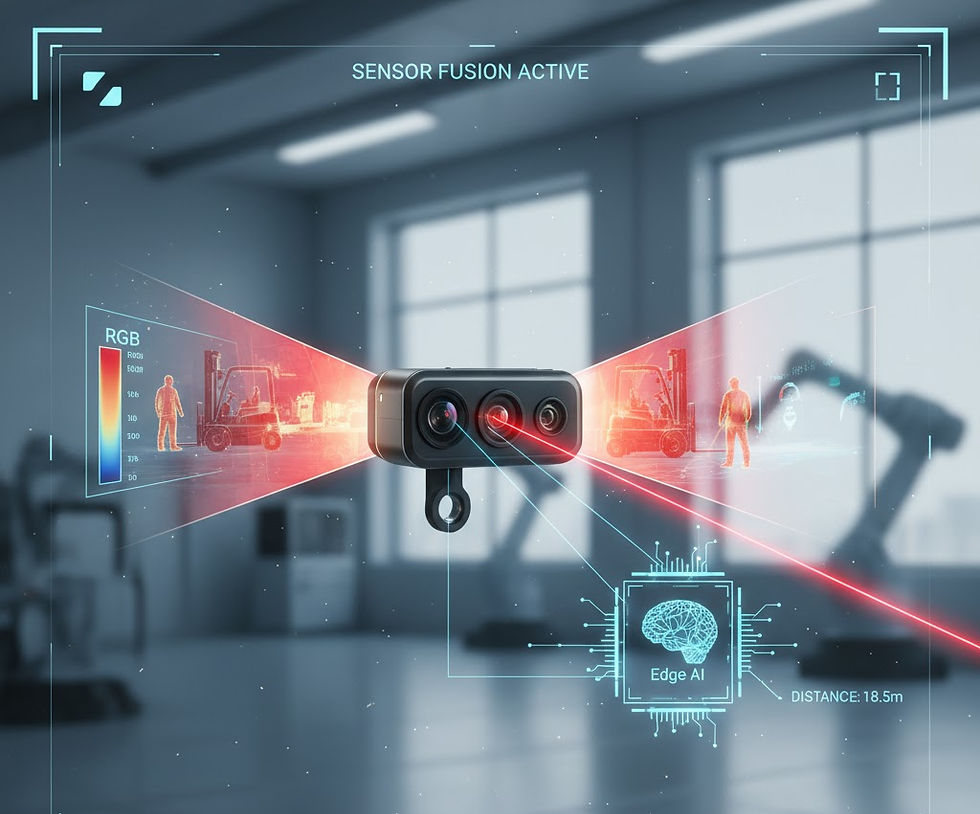
One of the unique characteristics of DOE modules is a natural intensity emphasis at the center of the pattern. While some might view this as a limitation, savvy R&D engineers use it as a computational anchor. In multi-sensor fusion, this central bright spot can serve as a fixed reference point, helping align RGB data with LiDAR or thermal overlays, ensuring that your AI model has a "ground truth" for spatial orientation.
Compact Integration for the Edge
The move toward Edge AI is driven by a need for compact, efficient hardware. Modern DOE modules are built on a rugged Φ9mm metal platform, making them small enough to be integrated into smart cameras or drone gimbals without adding significant weight or power draw.
Choosing Your Pattern
Line/Crosshair: Perfect for alignment, edge detection, and horizontal/vertical positioning in automated assembly.
Circle with Center Dot: Highly effective for centering and target acquisition in robotic arms.
Circular Spot: Ideal for uniform illumination in specialized sensing tasks.
The IntelliGienic Edge
At IntelliGienic, we specialize in helping customers bridge the gap between raw hardware and intelligent action. Whether you are integrating these DOE modules into a custom hardware design or developing the firmware to process their structured light data, we provide the expertise in AI vision and multi-sensor fusion to bring your creation to life.
Ready to upgrade your sensor suite?
If you're interested in applying DOE laser modules to your next creation, contact us to discuss how we can help you integrate these advanced optics into your next AI Vision project.


Comments